
When the Water Rises: A Sri Lankan Reckoning
Sri Lanka’s floods and landslides have exposed the fragility of our infrastructure and our detachment from ecology. This reckoning reveals a chance for collective reset — a return to soil, water, community and long-term thinking.

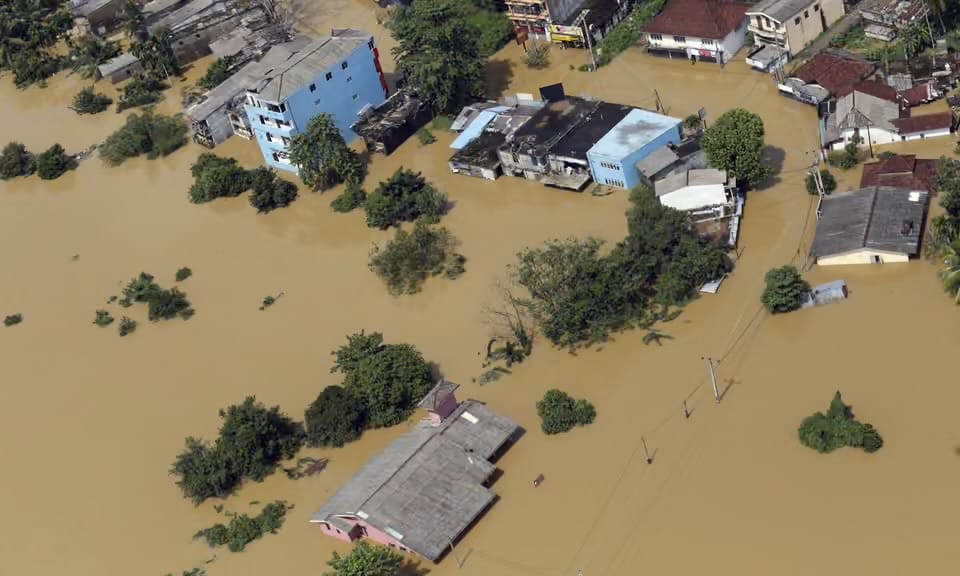
When water rises, it does more than displace homes. It displaces illusions.
Sri Lanka today is learning this truth the hard way. Floods seep across familiar roads, enter living rooms, silence routines, and force people into an unexpected stillness. The transience of comfort becomes unmistakable. The fragility of our systems—economic, ecological, emotional—sits exposed under a grey sky.
And yet, in this moment of disruption lies an unusual clarity. Crises have always been teachers. Floods, especially, have a way of washing the noise off our lives.
In the quiet after the sirens, a question appears:
What life were we living, and what life do we truly want to rebuild?
Nature Is Not Angry. It Is Honest.
It is tempting to see disasters as punishment.
They are not.
Nature does not retaliate. It recalibrates.
For decades, Sri Lanka’s landscapes have been asked to carry more than they can regenerate: forests cleared faster than they can heal, soil extracted instead of nourished, wetlands filled, rivers constrained, and our living patterns accelerated far beyond ecological logic.
The floods are not an attack.
They are a correction.
A reminder that even modernity must answer to the oldest laws of balance.
And nature—despite everything—is forgiving.
But its forgiveness comes with a condition: learn, or repeat the lesson.
The Real Damage Isn’t Water. It’s Disconnection.
Floods expose something deeper than structural weakness. They reveal the consequences of forgetting who we are in relation to the land.
Sri Lanka once understood water intimately. Our ancestors built cascading tank systems, worked with monsoons instead of against them, and cultivated landscapes as living systems. Resilience was not a strategy—it was a culture.
Today, resilience has become a press-release word. But culture cannot be replaced by jargon.
The true crisis is not rainfall.
It is the severed relationship between people and the ecological rhythms that shaped this island for millennia.
The Reset We Didn’t Ask For — But Desperately Need
In every flood-affected home, there is a moment—after the water stops rising, after the panic passes—where a strange stillness settles. That stillness is dangerous if wasted. It is powerful if used.
This is a national pause, forced but precious.
Our society is exhausted, disillusioned, and emotionally softer than usual. It is exactly in such psychological openings that real change—personal and collective—becomes possible.
A reset does not start in policy rooms. It starts in individuals deciding:
- to live lighter
- to waste less
- to repair instead of discard
- to choose soil-building over soil-depleting habits
- to treat water as a living relationship, not a convenience
- to grow something, even one small thing
- to teach children that nature is not a backdrop but a partnership
Sustainability is not activism.
It is remembering what we forgot.
Regeneration Begins in the Mud
As floodwaters recede, they leave behind two things: debris and opportunity.
Debris we know how to clear.
Opportunity, we often ignore.
Regeneration does not begin when conditions are perfect; it begins when conditions are honest. Mud-soaked floors and disrupted routines carry a quiet invitation to rethink everything we thought was “non-negotiable.”
Floods show us how little we actually need and how much we have overlooked.
They simplify us.
And from simplicity, regeneration becomes possible:
- communities reconnect
- local food systems strengthen
- land-based livelihoods regain dignity
- small-scale resilience replaces large-scale fragility
- people remember the weight of their choices
Resilience stops being a buzzword and becomes a behavior.
This Flood Will Be Remembered — But for What?
Sri Lanka will remember these floods for years. The question is how.
As a tragedy?
Or as a turning point?
Because floods, for all their destruction, give us something rare:
self-awareness.
They dissolve illusions of control, unmask our dependencies, and carve out a psychological willingness to rewrite how we live.
If we treat this moment as merely an interruption, the next flood will be worse.
If we treat it as a pivot, the next generation might thank us.
Nature is not asking us to be afraid.
It is asking us to grow up.
A Future Built on Humility and Long Horizons
The path forward is not complex—it is simply unfamiliar to a society trained for speed and immediacy:
- slow down
- listen to landscapes
- rebuild soil
- restore water pathways
- reduce excess
- redesign consumption
- protect the ecosystems that protect us
These are not environmental choices; they are civilizational ones.
The floods have delivered a message from the earth itself:
Live differently, or live at the mercy of your own shortcuts.
Redemption is possible.
Rebuilding is possible.
A more grounded, conscious Sri Lanka is possible.
But only if this moment becomes a turning point—not just a memory.