

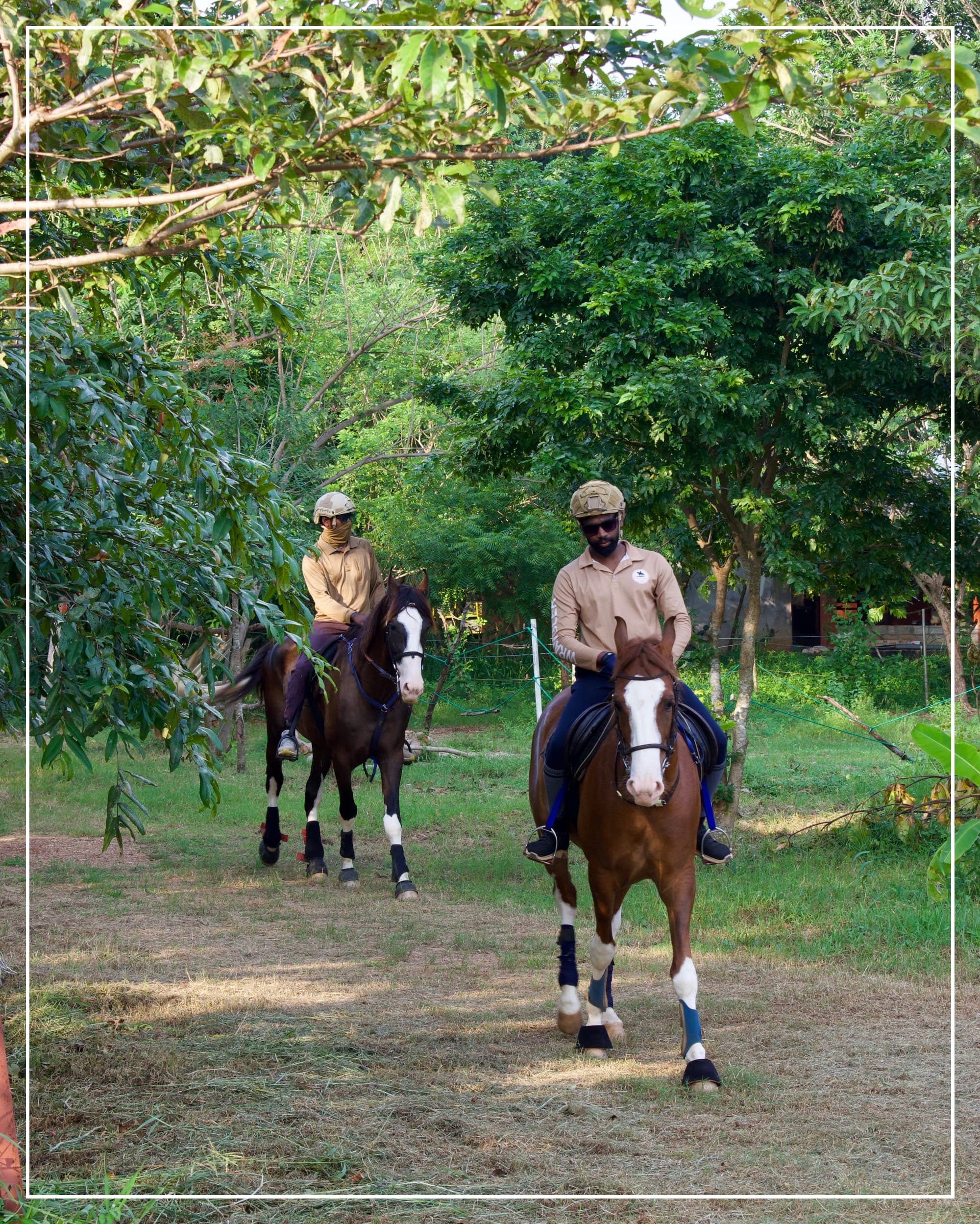
On a quiet morning deep in Sri Lanka’s interior, a trail horse reveals its quality long before a rider settles into the saddle. It shows in the stillness of the eye, the steadiness of breath, the way the animal reads the landscape without bracing against it. Good trail horses do not perform for the rider—they co-operate with the world.
Understanding what makes such a horse is not only an equestrian concern. It is a study of behaviour, personality, conditioning, and environmental psychology. This article examines the three pillars that shape a reliable trail horse: temperament, training, and terrain—and the subtle science that binds them.
1. Temperament: The Foundation of Reliability
Temperament sits at the centre of equine behaviour. It determines how a horse perceives novelty, processes stress, and responds to ambiguous situations on the trail.
1.1 Reactivity and Sensory Processing
Horses are prey animals with finely tuned sensory systems. A good trail horse is not defined by fearlessness—such a trait scarcely exists in nature—but by low reactivity and the ability to return to baseline quickly after a stimulus. Key traits include:
- Calm vigilance instead of hypervigilance
- Slow escalation during startle responses
- Predictable behavioural recovery
These qualities are partly genetic but significantly shaped by consistent human interaction.
1.2 Curiosity vs. Defensive Behaviour
Research on equine cognition repeatedly shows that curiosity is a strong predictor of trainability. Horses that approach novel objects—rather than avoid them—tend to form stronger partnerships with riders and adapt better to inconsistent terrain. This natural curiosity becomes the behavioural insurance policy on a trail.
2. Training: Clarity, Consistency, and the Absence of Conflict
While temperament provides the raw material, training determines how that temperament manifests under pressure.
2.1 The Role of Clear Signals
Horses learn through pressure-and-release, habituation, and associative memory. Confusion, not disobedience, is the most frequent cause of unsafe behaviour. Good trail training is therefore not about complex cues; it is about uncluttered communication.
A well-trained trail horse:
- Understands forward movement as the foundational response
- Maintains rhythm without constant input
- Reads weight, breath, and micro-pressure
- Distinguishes between threat and inconvenience
2.2 Emotional Regulation Through Repetition
Repetitive exposure to controlled variations—different footing, unexpected wildlife movement, wind, light changes—helps build a horse’s emotional library. The goal is not to desensitise completely but to normalize variability. Training that cultivates emotional regulation leads to the behavioural stability that riders often describe as “confidence.”
2.3 Trust as the Operational Currency
A trail horse is a decision-maker. No rider, regardless of skill, can micromanage every second of a multi-hour expedition across forest or mountain terrain. What matters is whether the horse:
- Trusts the handler
- Trusts itself
- Trusts its understanding of the environment
Trust is not sentimentality; it is an operational asset, built through time, fairness, and clarity.
3. Terrain: The Environmental Architecture of Behaviour
A horse trained exclusively in arenas cannot reliably interpret terrain. Conversely, a horse shaped by diverse landscapes becomes an adaptive, confident trail partner.
3.1 Terrain Creates Cognitive Maps
Horses develop mental maps of the world through movement. Trails, slopes, rivers, and forest lines create spatial memory. Horses conditioned in multi-terrain environments typically show:
- Better proprioception
- More efficient gait changes
- Greater environmental acceptance
3.2 Footing Literacy
One of the least-discussed elements of trail science is footing literacy—a horse’s ability to understand the surface beneath it. Different terrains teach:
- Rock and gravel: careful hoof placement
- Wet soil and clay: balance and patience
- Forest cover: auditory processing
- Open fields: speed modulation and awareness
Horses trained with environmental literacy become more autonomous, safer, and less stressed.
3.3 Terrain as a Behavioural Mirror
Challenging terrain exposes behavioural truth. A horse may appear calm in controlled spaces but reveal tension when faced with:
- Narrow bridges
- Water crossings
- Wind tunnels in forest corridors
- Moving shadows
This is not failure—it is feedback. The terrain becomes a diagnostic tool for training gaps and temperament traits.
Conclusion: The Integrated Horse
A good trail horse is not purely a product of breeding, training, or environment, but of the integration of all three. Temperament provides the baseline, training shapes the behavioural vocabulary, and terrain completes the psychological and physical conditioning.
When these elements align, the result is a horse that moves through the landscape with quiet confidence—an animal capable of carrying riders safely through environments that demand cooperation between instinct, experience, and trust.
Trail horses are, ultimately, a testament to the idea that reliability is engineered, not assumed.