

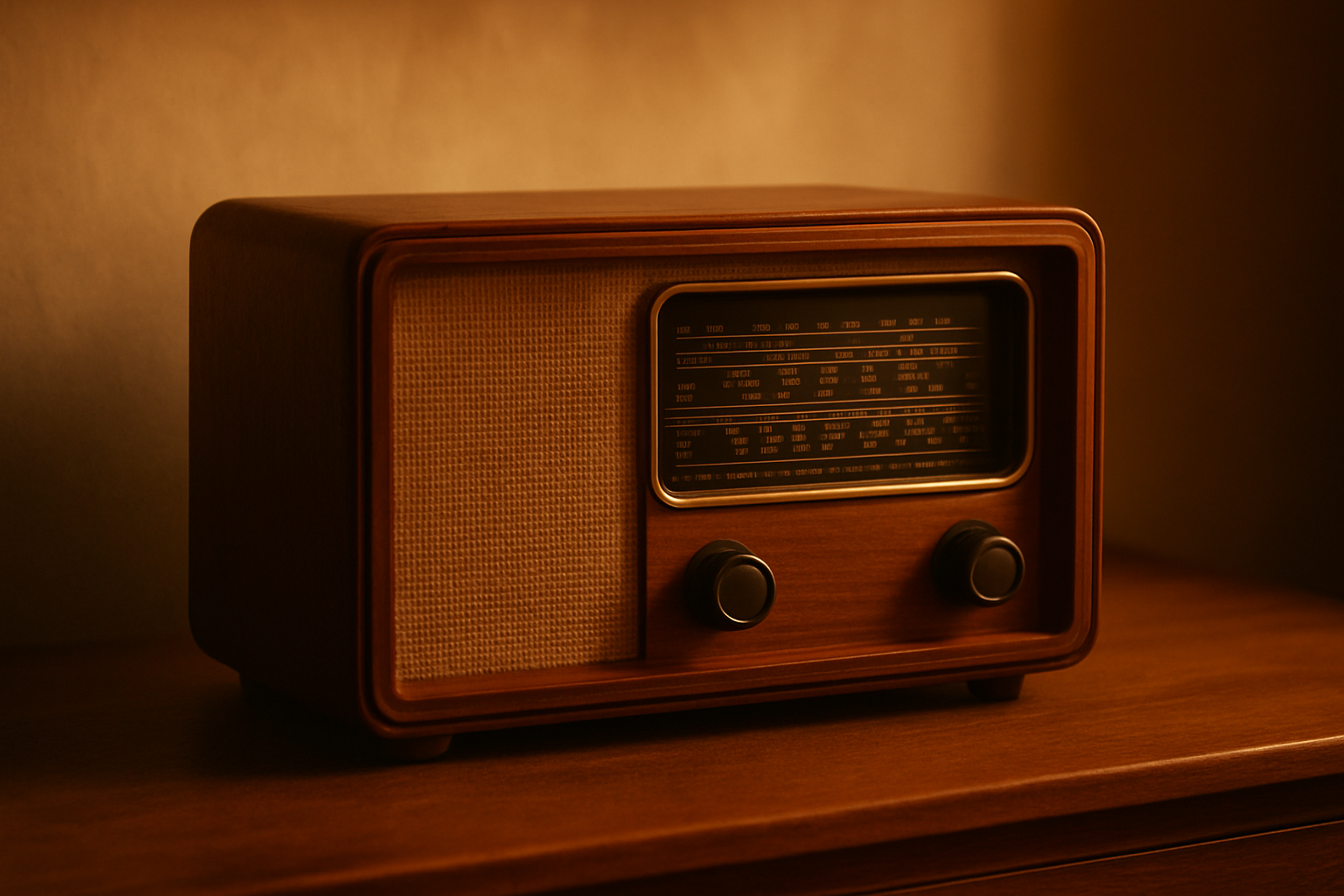
There was a time when stories did not compete with machinery. They did not shout from screens, autocue their punchlines, or claw for a click. They were simply told — in rooms, on porches, through open windows in the soft fall of evening. In that older world, a voice had room to breathe and a listener had room to listen.
Garrison Keillor emerged from that world and somehow kept it alive long after the world itself had slipped away. What he practiced was not showmanship, nor performance in its modern, caffeinated sense; it was companionship. A gentle presence threading the distance between speaker and listener, using nothing more elaborate than breath, silence, and a story well-paced. He was, in his quiet manner, the last bard of radio silence — an artist who understood that in storytelling, the pauses matter as much as the words.
In a culture addicted to amplitude, Keillor built a refuge out of understatement. His voice carried the soft authority of an evening kitchen: unhurried, conversational, unpretentious. He was not trying to impress. He was keeping company. And in that act — simple, steady, tender — he restored to countless listeners the sense that they were still part of a shared human rhythm.
But it wasn’t nostalgia that made Keillor important. Nostalgia is easy; anyone can sentimentally recall a gentler past. What made him rare was his discipline: the choice to preserve a manner of storytelling that refused the violence of urgency. When everyone else was raising their volume, he lowered his. Where others delivered jokes like projectiles, he offered them like folded notes quietly slipped across a table. He trusted the listener, and in doing so, reminded us what trust felt like.
There is a cultural critique buried in this gentleness. Keillor’s work reveals how deeply modern communication suffers from its compulsion to perform. The digital age has turned speech into spectacle, conversation into broadcast, presence into exposure. The pressure to be loud has reshaped not only our public voices but our private ones. We no longer speak in order to be heard; we shout in order to be seen.
Keillor, through decades of steadiness, posed an implicit question to all of us: What if a story could simply sit beside you instead of chasing you?
His answer, delivered through thousands of hours of radio, columns, and meandering monologues, is that the quieter truth often endures longer. His humor — never cruel, never acid — resisted the cynicism that passes for sophistication in public life. He practiced tenderness as a form of civic responsibility, reminding us that humanity is not found in the grand declaration but in the modest admission, the faint embarrassment, the sigh tucked into a sentence.
In our current landscape of jet-stream attention and swarming commentary, Keillor’s legacy looks almost radical. He proved that wonder does not require spectacle, and that an entire emotional architecture can be built on small, deliberate moments: a shy teenager’s violin recital, a Lutheran potluck, the weather report from a town that exists mostly in the imagination but feels more real than much of the world around us.
To appreciate Keillor is to appreciate an ethic — one that values listening as much as speaking, and the shared silence between two sentences as much as the sentences themselves. He is a reminder that storytelling, at its highest form, is an act of companionship. The storyteller says, in essence: I’ll walk with you for a while. The road is long. Let’s talk.
In an age that has all but outlawed gentleness, that offering still feels astonishing.
Author’s Note
I write this in admiration of Keillor’s restraint — a quality increasingly rare among storytellers. His devotion to quiet craft remains, for me, a standard worth defending in a noisy age.