
Great Heroes Day, the Three M’s, and the Enduring Psychology of Tamil Eelam: Implications for Sri Lanka’s National Security and Intelligence Landscape
More than fifteen years after the LTTE’s defeat, Great Heroes Day continues to shape identity, memory, and security in Sri Lanka. Former intelligence chief Mahil Dole examines its psychological, political, and strategic significance.

By Mahil Dole, SSP (Retired)
Former Director of Counter-Intelligence & Head of the Counter-Terrorism Division, State Intelligence Service — Sri Lanka
Synopsis
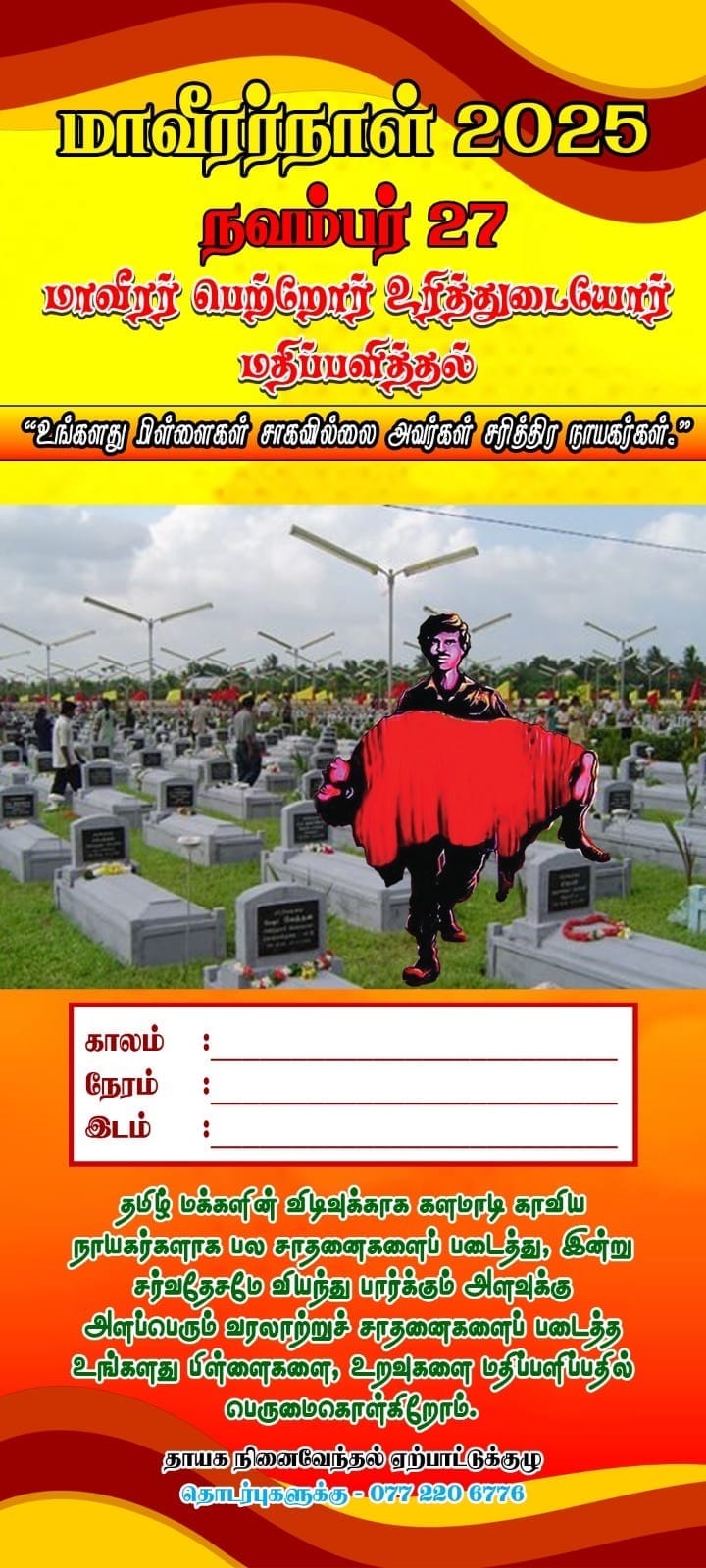
More than fifteen years after the military defeat of the LTTE, Sri Lanka continues to live with the political, psychological, and security implications of the Tamil Eelam struggle. Each November, these tensions visibly resurface as the Tamil community—locally and across the diaspora—prepares to commemorate Great Heroes Day, a ritual that remains one of the strongest symbols of LTTE ideological continuity.
Despite the absence of militant structures, Great Heroes Day retains immense motivational value, reinforcing narratives of sacrifice, martyrdom, and an unfinished struggle. For Sri Lanka’s intelligence community, this presents a complex challenge: navigating the emotional landscape of a defeated yet psychologically alive movement within a political environment shaped by domestic pressures, diaspora activism, and regional geopolitical interests.
Great Heroes Day: Origins and Psychological Power
Great Heroes Day has been observed on 27 November since 1989, marking the death of Shankar, an LTTE cadre closely associated with Velupillai Prabhakaran. Critically injured in Jaffna, transported by boat to India, and ultimately dying in Prabhakaran’s lap, Shankar became a deeply personal loss that transformed into a collective symbol—evolving into the foundational commemorative day of the envisioned state of Tamil Eelam.
The LTTE framed this day as “Elluddi Naal,” carrying a dual meaning:
- A Day of Edification
- A Day of Rising
Although presented as mourning, the deeper purpose was motivational—transforming grief into renewed commitment. By ritualising sacrifice, the LTTE created a psychological mechanism through which every death became a symbol of resurgence, not defeat.
Tamil Eelam: Militarily Defeated, Psychologically Alive
While the LTTE was militarily eliminated in 2009, Tamil Eelam survives in psychological, emotional, and political form. Among Sri Lankan Tamils and the international diaspora, it functions as:
- an identity anchor,
- a political bargaining instrument,
- a strategic narrative leveraged by multiple actors.
Each year, Great Heroes Day revitalises this narrative, sustaining emotional memory and framing the past as an unfinished mission.
The Three M’s — The Oxygen of a Movement
During my tenure as Intelligence Coordinator to the Inspector General of Police, I was sent to the Northern Province to conduct a threat assessment ahead of a presidential visit. The assignment included evaluating risks surrounding development projects—such as the Sangupiddy Bridge inauguration, agricultural assistance, and digital education initiatives—designed to win hearts and minds.
During this visit, I re-established contact with two senior former LTTE cadres who had undergone rehabilitation and remained under state intelligence supervision. It was through these interactions that the enduring ideological architecture of the LTTE became clear.
Insights from the Field
When asked about rehabilitation, one of them responded:
“I was with the LTTE hierarchy for so many years—can such a person truly be rehabilitated? I follow Sun Tzu: when you are with the enemy, do what the enemy says—to live for another day, and to fight another day.”
His compliance with rehabilitation was strategic, not ideological. His allegiance had not disappeared—it had merely gone underground. Patience, not surrender, defined survival.
It was this same individual who articulated the LTTE’s long-term formula—the Three M’s, which he described as the movement’s “oxygen.”
1. Motivation
Pointing to war-scarred buildings and the remnants of conflict, he said:
“These ruins are our monuments of motivation.”
Then, tapping the scar on his arm:
“Every wound, every loss, every story keeps the cause alive. These motivations cannot be erased.”
The physical environment—ruins, scars, cemeteries—functions as a living motivational archive.
2. Men — Human Resource
With quiet certainty, he continued:
“The LTTE is sleeping. They will rise at the right moment. The university students are our next generation.”
That same year, university students commemorated Great Heroes Day despite heavy monitoring—validating his belief that ideological transmission continues.
3. Money — Material Resources
Finally, he stated:
“We have enough money. The diaspora will supply what is needed, when needed.”
Fifteen years later, diaspora funding networks remain active through remembrance events, nonprofits, advocacy groups, and online mobilisation.
The Enduring Echo of the Sudumalai Statement
He also reminded me of Prabhakaran’s Sudumalai Statement delivered at Nachchimar Kovil on 4 August 1987:
“The methods of war may change, but the aim of the war will not change.”
“Our thirst is Tamil Eelam.”
According to him, these words “still linger in every household in the North.” This illustrates how narrative memory functions as a long-term motivational device, sustaining emotional allegiance even after organisational collapse.
Among all LTTE messaging, the Sudumalai Statement remains one of the most potent sources of psychological continuity— transmitted across generations.
How the Intelligence Community and State Respond Today
For Sri Lanka’s intelligence services, Great Heroes Day remains an annual strategic and operational challenge. Historically, aggressive suppression strengthened separatist narratives. Today, sensitivities are even more complex:
- Tamil political actors invoke commemorative messaging for electoral leverage,
- the diaspora uses the date to lobby foreign governments,
- India, the West, and international institutions monitor developments,
- activists frame security responses as ethnic repression.
In this context, intelligence handling requires a calibrated, layered approach:
1. Persistent Surveillance
Monitoring organisers, diaspora networks, student mobilisation, and online propaganda.
2. Distinguishing Symbolism from Threats
Not every commemoration poses imminent danger—but every commemoration sustains ideology.
3. Balancing Security with Political Sensitivity
Overreaction fuels grievance; measured engagement prevents escalation.
4. Addressing Root Causes
Counter-narratives and development—not policing alone—reduce motivation.
The Psychological Engine
Great Heroes Day is not merely a memorial event; it is a psychological engine sustaining the emotional life of the Tamil Eelam narrative. The LTTE’s Three M’s—Motivation, Men, and Money—continue to resonate through memory, symbolism, and diaspora activism.
My field experience demonstrated that even after rehabilitation, ideological commitment may survive in sublimated, dormant form. The Sudumalai Statement, Shankar’s legacy, and the symbolic meaning of Elluddi Naal continue to reinforce loyalty, identity, and purpose.
For Sri Lanka, the challenge is not only preventing violence, but managing the psychological and political terrain in which narratives, memories, and symbols remain powerful long after the battlefield has disappeared. The struggle has shifted—from jungles and weapons to emotion, identity, and meaning.
Great Heroes Day remains at the centre of that enduring landscape.
About the Author
Mahil Dole, SSP (Retired), served as Director of Counter-Intelligence and Head of the Counter-Terrorism Division at the State Intelligence Service of Sri Lanka. He has represented Sri Lanka as Head of Delegation at multiple BIMSTEC security conferences. With over four decades of experience in policing, national intelligence, and strategic security, he writes on regional security, interfaith dynamics, and geopolitical risk.