
After Ditwa: What a Cyclone Quietly Revealed About Governance, Trust, and Sri Lanka’s Changing State
Cyclone Ditwa tested more than Sri Lanka’s infrastructure. It tested the State itself. From international confidence to calm military deployment and rapid institutional correction, the response revealed early, tangible signs of functional good governance under real pressure.

An intelligence-informed civil society interpretation of disaster, credibility, and institutional change.
When Cyclone Ditwa struck, the first story was about wind, water, and destruction. But almost immediately, a second story began unfolding beneath the surface: a story about how institutions behave under pressure, how the world responds to that behaviour, and how political reflexes react when competence quietly displaces noise.
From an intelligence, civil-society, and governance-analysis standpoint, Ditwa became far more than a natural disaster. It became a real-time stress test of the State itself. And the results point to a conclusion many Sri Lankans are now sensing intuitively:
Sri Lanka is operating in the early, tangible stages of good governance.
Not as a slogan. Not as a campaign message. But as an observable pattern of conduct.
What the International Response Actually Tells Us
To the average citizen, foreign assistance appears as aircraft landing, relief teams working, and supplies being distributed. But in diplomatic and intelligence communities, the speed, diversity, and continuity of aid carry very specific meaning.
Nations do not move assets rapidly for governments they do not trust. They do not release emergency funding into systems they believe will leak. They do not embed technical teams into environments they expect to fragment or politicise. These are sober institutional judgements, not sentimental gestures.
In the aftermath of Ditwa, three clear signals emerged:
- Assistance moved quickly with no visible diplomatic friction.
- Support came from a broad range of states, not only traditional partners.
- Aircraft and aid flows continued over several days, not as a one-off display.
This pattern is not unique to Sri Lanka. It is historically consistent across post-stabilisation moments in Europe, Southeast Asia, and Latin America. The signal is universal:
When governance stabilises, the world responds faster.
Ditwa did not create this trust. It revealed that it already exists.
The Early “Delay” Narrative – and What Actually Happened
In the first hours after Ditwa, portions of social media and some opposition voices framed the response as “slow”, particularly in relation to military deployment. Emotionally, this is understandable. Disaster breeds impatience. Operationally, however, it reflects a misunderstanding of how effective deployment actually works.
An experienced State does not deploy forces for visibility. It deploys for outcomes. Moving personnel into view without proper assessment risks theatre rather than solution. At ground level, including within the Police and certain first-response units, genuine communication gaps existed.
After years of economic collapse, frontline units were operating below optimal equipment thresholds. Radio procurement had not kept pace with operational needs. This was not institutional negligence; it was the residue of national financial exhaustion.
Effective disaster deployment requires:
- Ground assessment and situational mapping
- Communication synchronisation
- Logistical routing and engineering clarity
- Safety confirmation for responders and civilians
The short initial run-up was therefore not paralysis. It was controlled preparation to avoid blind deployment into unstable terrain.
When the Military Moved: Sustained Results, Not Optics
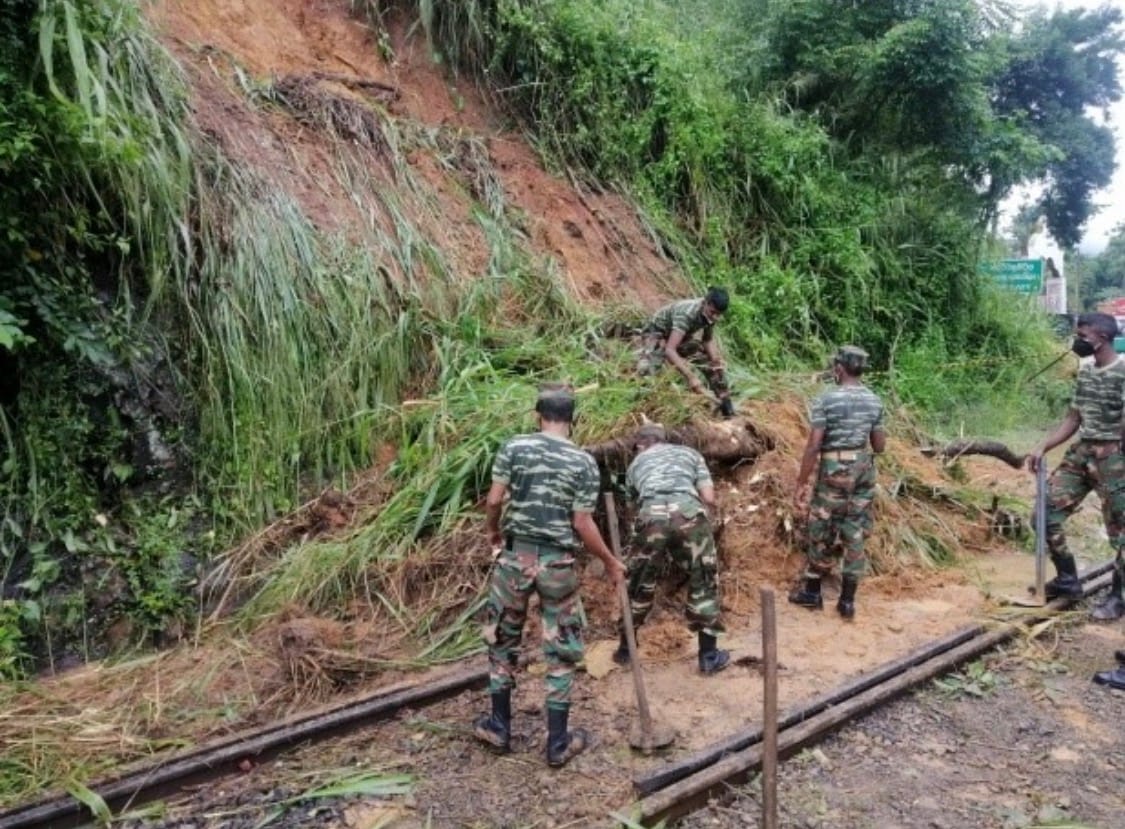
Once full deployment commenced, it did not arrive as spectacle. It arrived as sustained operational effort. Roads were cleared at speed. Arterial access routes reopened. Engineering units worked continuously. Civil–military coordination remained constant.
Public sentiment changed not because narratives shifted, but because outcomes became visible and measurable.
When the helicopter tragedy occurred, the national response was deeply emotional. In that moment, it became clear that public trust in these institutions is not abstract. It is human, personal, and deeply felt.
A Quiet Institutional Learning Loop Has Now Activated
One of the clearest indicators of governance maturity is not flawlessness, but speed of correction.
Post-Ditwa, new radio procurement has already begun within the Police. Other services are expected to scale communications accordingly. This is how functional states evolve: through correction, not denial.
The Opposition’s Reaction: A Psychological Reading
When competence becomes visible, political ecosystems shift. Relevance anxiety, rhetorical escalation, and confirmation-bias reinforcement are global behavioural patterns.
The reactions observed fit that pattern precisely.
How the Public Is Reading This Moment
Citizens compare lived experience, not ideology. They feel difference before they name it. During Ditwa, what many experienced was coherence under pressure.
A Quiet National Turning Point
Cyclone Ditwa did not simply damage infrastructure. It confirmed that Sri Lanka has entered an early stage of functional good governance.
About the Author
Alfie Ameer is an intelligence and risk analyst and the Founder & Chief Executive Officer of Vonfidel Group. His work focuses on governance behaviour, institutional stress performance, and the psychology of national security systems.
Drawing from intelligence analysis, organisational behaviour, sociology, psychology, anthropology, and public policy, he studies how states rebuild legitimacy, institutional capacity, and public trust after periods of systemic disruption.
He writes to translate complex institutional behaviour into clear public understanding, without partisanship and without spectacle.